Showing posts with label china pavilion. Show all posts

Tuesday, October 19, 2010

Closure of China Pavilion for a Month after Expo 2010

China Pavilion at Expo Shanghai
The Shanghai World Expo will last until October 31, 2010. The most popular China Pavilion is a project for permanent exhibitions, but it will close for a month in November. The animated version of the famous Chinese painting scroll "Riverside Scene at Qingming Festival" will be moved to Hong Kong for display during the period from November 9 to 29, 2010. The exhibition will be held at the Asia World-Expo venue, Hong Kong International Airport from 10:00am till 9:00pm for 11 hourly sessions each day during the concerned period. The setting of the rendition will be mildly adjusted when comparing to its display in the China Pavilion. Ticket sales in Hong Kong has started from today through 41 URBTIX outlets and cost HK$10 each.  Sixteen thousand tickets which are about one-fourth of the total ticket volume have been sold today. Starting from tomorrow October 20, 2010 onwards, tickets can also be purchased through online ordering (http://www.urbtix.hk) or credit card telephone booking services (Tel: 21115999). For more information, please visit http://qingmingriverside.hk/en/. For inquiries, please call 1823. Hong Kong residents are very fortune to see the "Riverside Scene at Qingming Festival" without going to Shanghai or waiting in long queues. Starting from December 1, 2010, the "Riverside Scene at Qingming Festival" will return to Shanghai for permanent exhibitions in China Pavilion. 


Daytime activities as described in the famous ancient Chinese painting "Riverside Scene at Qingming Festival" presented in the China Pavilion

Thursday, July 8, 2010

100,000 Visitors Had Benefited from the Fast Track System

Signboard explaining the fast track system
The Shanghai Expo authority yesterday announced that more than 100,000 visitors had benefited from the fast track system to obtain reservation tickets for the designed popular pavilions. During the process, visitors should firstly obtain a copy of the City Name Card. After the card has been stamped with 16 chops from the Urban Best Practices Area (UBPA) Cases (please refer to my blog dated June 12, 2010 for details), the visitor can exchange the card for a reservation ticket to one of the three popular pavilions - the China, Saudi Arabia, or Italy Pavilion. The Italy Pavilion started joining the system this month. In order to be able to get accessed to the Italy National Pavilion, one should go to the Cases of Venice, Bologna and the country's environment protection department to collect 6 UBPA stamps. There are limited editions of the cards. Every day the system offers 500 chances to the admission to the Italy Pavilion, 180 to the Saudi Arabia Pavilion, and 2,000 to the China Pavilion. Visitors who are interested in the Germany, Spain, and Czech Republic Pavilions, may go to the three countries' cases to collect a certain number of stamps. A notice is posted at the Information Counter for the explanation of the procedures (See attached photo). Once you have got the reservation ticket for the China Pavilion, you don't need to follow the time slot. It is quite free. The staff will only check the date. He/ she will let you go in even though the booking time has passed.
UBPA at Puxi section of Expo 2010
The fast track system has made the UBPA become popular. The number of attendances to the UBPA increases to almost 10 folds than that before the initiation of the system. The system has also generated more visitors to Puxi. A university teacher was very lucky to be the 100,000th visitor receiving the City Name Card. The luck had brought him a gift package including reservation tickets to the China, Saudi Arabia, Italy, Germany, and Czech Republic Pavilions.
Besides the offers from the fast track system, one can get accessed to the designated pavilions if he or she holds a valid VIP card. Some foreigners said that they could skip the queue to enter their country's pavilions by showing their legal passports. For example, a visitor who is holding a valid French passport is allowed to get into the France Pavilion straight away. I, however, have no way to validate this information.

Monday, June 28, 2010

"Super Rice" Growth at Expo 2010 shanghai

Super rice planting
World expositions are optimal places for acquiring knowledge. Before visiting Shanghai Expo 2010, I have never thought of learning something about rice. I know little about agricultural planting. After I have been to the "super rice" exhibition at China Pavilion in Expo 2010, I start realizing that the Chinese government has been putting very much effort on the research of hybrid rice engineering technology. Super rice is China's key agricultural development with phase accomplishment in rice increase production. What is super rice? It is interesting to learn about it.
What is super rice?
Hybrid rice is produced by crossbreeding of different types of rice. Super rice refers to the rice variety that has a significant increase output. In the section "Land of Hope" at China pavilion, live super rice plants were displayed. They appeared to be healthily tall and strong. Grains were in golden color. The staff of the pavilion introduced the super rice to us. It is the latest specie of high-yield hybrid rice developed by the "Father of Hybrid Rice" Yuan Longping and co-researchers. The study of super rice is an on-going project since the birth of the first generation of hybrid rice in 1970's. The current variety of super rice has more than  30% output than the ordinary rice. In order to display the flowering plants, 16 batches of super rice had been planted with different seedling time. Each batch of super rice would be transferred to the display  area and stayed there for 7 to 10 days. The first batch of flowering super rice had been transported to China Pavilion, and the rice seeded in May would be matured in September.


The Land of Hope at China Pavilion in where the super rice is shown

Monday, June 21, 2010

China Pavilion at Expo 2010

China Pavilion
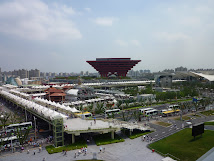
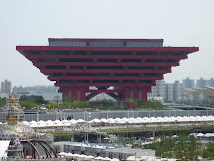
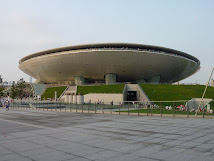
The China Pavilion is the top  attraction in 2010 Shanghai Expo. Its building is grand and magnificent, blending the modern architecture with a taste of the ancient Chinese culture. The theme of the China Pavilion features the Chinese wisdom in urban development. In the first section of the exhibition, we watched a short movie which showed cases of Chinese's experiences in urbanization over the past 30 years. We then moved to the main gallery in where we were fascinated to see a giant animated rendition lively presenting a scene of Chinese people' activities during a festival back to the days 900 years ago. The scene is an imitation of the famous ancient Chinese painting scroll "Riverside Scene at Qingming Festival". In the picture, animated characters were shouldering commodities, selling groceries, riding donkeys, enjoying dinners, rowing boats, etc. We strolled along the "bank" of the animated "river" which stayed right below the 128 meter-long animated rendition. Referring as one of the China's national treasures, the real painting of the "Riverside Scene at Qingming Festival" was also displayed in the pavilion. Other displays were valuable antiques in the hall "Crystals of civilization".
Architecture China Pavilion
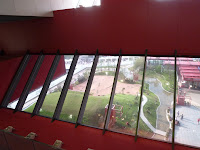
In the second section, we came to the "Land of Hope". There were projections of future apartments showing how people would improve their quality of life in cities. In the agricultural area, there were displays of super rice which were tall and strong. One of the signboard's indications was the emphasis of rural-urban harmony. In further explorations, we entered the hallway in where children paintings were displayed. Peeping through the glass wall of the hallway, we could view distant scenery of the Expo site and people lining up in front of the China Pavilion. We were, in fact, staying as high as in a modern high-rise building. Getting into another exhibition hall, we found a chance to rest our tired legs by riding an excursion train. The train tour offered us a dynamic and exciting journey of discovery and enabled us to learn about Chinese wisdom in city planning. 
Looking down from the China Pavilion

The final section of the exhibition expressed the  effort of the Chinese government in the advocacy of low-carbon lifestyle to its citizens. Energy saving facilities such as wind power generators and LED bulbs were displayed. Reaching the end of the exhibition hall, we came to a large ring-shape lotus pond surrounded by sliding rains. We got into the center part of the lotus pond and stepped onto the extraordinarily long escalator which sent us down to the open-area podium. Passing the Chinese garden, we got our way to the exit. 


Watching the animated painting scroll


Part of the animated version of the ancient Chinese Painting scroll "Riverside Scene at Qingming Festival" 


The greatest attraction in the China Pavilion

Wednesday, June 16, 2010

Optimal Choice of Entrance Gate to the Expo Site

Reservation spot at Zone E Puxi
There are in total 13 entrances/ exits for the Expo site. Many people are making searches for the optimal choice of the entrance to the Expo site. That entirely depends on the zone area where you would like to pay a visit to. As the Expo site is extremely large, it is not possible for you to tour all 5 zones in a day's visit. More than 70% of the site area is in Pudong where most people are interested in. Fewer visitors are found in Puxi because there are fewer attractions. 
The China Pavilion remains to be the most popular visiting point in Expo 2010. Gate 5 (Gaoke Road West) is comparatively close to the China Pavilion. It is also not too far a distance if you walk along the Expo Boulevard from Gate 6 (Shangnan Road) to the China Pavilion. Many visitors rushed to the China Pavilion from Gate 5 in the very early morning with an eager for the visit. However, they couldn't achieve the visit without a reservation ticket. Therefore, it is wise to reach the reservation spot to obtain a ticket first. There is not any reservation machine at the China Pavilion. All reservation spots are far away from the China Pavilion. I am not quite sure about the reservation spots in the Pudong section. But I know that there is a reservation spot at Zone E of Puxi. This is close to Gate 3 (Bansongyuan Road), but Gate 3 is not directly connected to any metro line. If you go by subway, you may consider going through Gate 1 at Zone D and take a free shuttle bus to reach the reservation spot in Zone E. Puxi is less crowded with people. 
Since the opening of the Expo, the greatest number of admissions has been from Gate 8 (Houtan Gate) at Zone C. This is the zone where the American, European, and African Pavilions are sited. This area is always crowded with people. There are 3 shuttle bus routes staring from Gate 8 to reach various pavilions. The Shibo Avenue bus route is the best choice if you would like to go to the UK, France, Switzerland, and Spain Pavilions. It is also not too far away to walk from Gate 8 to the USA Pavilion. Based on the official statistics, Gate 8 received 80,000 visitors on June 13, 2010. On the same day, Gate 7 (Changquing Road) received 65,000 visitors. The other 3 gates at Pudong are also crowded.
Instead of waiting long at the gates in the Pudong Section, you may consider entering the Expo site from Gate 1 at Puxi and take the subway Metro Line 13 (Lupu Bridge) to Pudong. After getting out from the Shibo Avenue Metro Station, you can make an easy access to the Australia, Finland, or Denmark Pavilion. It may be more fast than you enter from the gates at the Pudong section.

Tuesday, June 15, 2010

Permanent Expo Projects in Shanghai

Escalators of China Pavilion
 A friend asked whether or not the 2010 Expo would be extended so that he could have a chance to go in November. The answer is unfortunately not because there are international rules to follow. The 2010 Expo will last until 31 October 2010. Five structures namely the China Pavilion, Theme Pavilions, Expo Boulevard, Expo Center, and Cultural Center, will stay permanently (The Theme Pavilions include the Urbanian Pavilion, Pavilion of City Being, Pavilion of Urban Planet, Pavilion of Footprint, and Pavilion of Future in Zone B, D, and E respectively). After the closure of the Expo, there will still be chances to visit these areas. Therefore, some visitors make their smart plans by visiting these permanent projects in later days. 
Escalators of China Pavilion
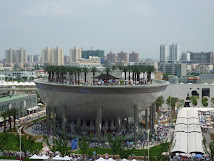
The China Pavilion will surely become the landmark of Shanghai. The design of the China Pavilion is based on the concept of the Oriental Crown to express the spirit and deposition of Chinese culture. All exhibition halls are sited on the upper floors. As a start, visitors have to ride a lift to the main exhibition hall where is located on the top floor. After they have finished all exhibitions, two extremely long escalators will take them down to the podium. People will see these escalators from the outside of the Pavilion. Some people said that these two escalators contradict Feng Shui, thus will be demolished after the Expo.
There is an unofficial saying that the Saudi Arabia Pavilion will be retained as there is a wish from its fans who are not patient enough to line up for hours for the entry. Others said that five most beautiful foreign pavilions will be allowed to retain permanently. However, China has officially denied the rumor.


There is a lotus pond inside the China Pavilion. It is connected by two extremely long escalators to the Chinese garden on the patio of the building.

Saturday, June 12, 2010

Fast Track to the China Pavilion in Expo 2010

Signboard showing the way
Among the many exhibitions in Expo 2010, the China National Pavilion has been many visitors' top interest. To get access to the China Pavilion, one should firstly get a reservation ticket ready at hand. However, the demand for tickets is far greater than the supply. Therefore, many people feel disappointed in the failure getting a ticket from the reservation spot. There were some discussion messages left on the community networks saying that it was hard to get a reservation ticket. In the following paragraph, I am going to show you an optional route to achieve an access to the China Pavilion. 
Starting from May 19, 2010, there is a fast track option to obtain reserved tickets. After visitors have finished collecting 16 stamps from a visit to the Urban Best Practices Area (UBPA) in the Expo's Puxi Section, they can trade it for a reserved ticket for either China Pavilion or Saudi Arabia Pavilion. The stamps should include 15 UBPA cases (7 Asian, 7 European, and one American/ African cases) and one from the entry point to the site. Stamps should be issued in a booklet entitled "City Name Card" which can be obtained in Zone E, Puxi. There are signs leading you to the site once you are in the area. And there are volunteers helping you for the direction. Please be aware that such fast track is for individual visitors only. Group visitors are not entitled for the fast track offer.
City Name Card for China Pavilion
When we reached the distribution point for the "City Name Card" booklets at around 09:30am, the booklets for the China Pavilion are still available. However, the booklets for the Saudi Arabia Pavilion had all gone. As we are aware, 900 to 1,000 booklets for the China Pavilion will be distributed every day, but only 500 per week to the Saudi Arabia Pavilion. If people can't finish collecting the stamps within the same day, they can continue the collection when coming to the site again. In the reality, people can finish visiting the 15 UBPA cases quickly because there are not much to see and visitors don't need to wait for a moment. Some city cases have only a counter in the UBPA pavilion. After the completion of the 16 stamps, visitors can go to the Puxi Information Center in Zone E for the trading. For updates, please check the official Expo website http://www.expo2010.cn/ in case of any policy changes.

City Name Card for Saudi Arabia Pavilion
 

Friday, June 11, 2010

World Exposition Museum in Expo 2010

Preface-Expo City of Mascots
The first world exposition was initiated in London, United Kingdom, in 1851. It was soon held in turns by various cities in the world. Such world fairs provide countries with good opportunities to learn from one another the progress and achievement in new concepts, new inventions, new technologies, new cultures, and new lifestyles. Universal expositions are the showcases where technological advancement could be shown, as well as the platforms where innovative ideas could be brought together.
It would be great if we could learn more about what people thought when firstly seeing the display of the Otis elevator in New York City's World Fair in 1853. Did people feel amazing at the very first time talking via a telephone line in Paris' World Fair in 1878? The juicy fruit gum came up in Chicago's World Fair in 1893. Ice-cream cones and aircraft showed up in St Louis' World Fair in 1904. Tape recorders and televisions appeared in New York's World Fair in 1939.
I expected the above would be found in the current World Exposition Museum in the Shanghai Expo, but I was wrong. Instead, we saw both eastern and western human history in the Museum. There was a display of the Preface-Expo City of Mascots. If you ask me whether it is worth to pay a visit to the World Exposition Museum, I would say yes. It is because there is a display of the most precious oil painting of the first World Expo at London. After all, we had only spent 10 minutes for the entire visit. There was not any queue at the entrance. The World Exposition Museum is opposite to the Pavilion of Footprint at Zone D in Puxi. If you are going to the Pavilion of Footprint, you may consider going to the World Exposition Museum too.

Monday, May 3, 2010

The Third Day of the Expo 2010 - What to bring in

Queuing for a pavilion admission
It's the third day since the opening of the Shanghai World Expo to the public. The weather of Shanghai is hot with temperature around 29 degrees Celsius for most of the time today. It will be a good idea to bring along with a pair of sun glasses, an umbrella, or a cap. For security reasons, visitors are not allowed to bring along with any liquids into the Expo site. A small tube of sun protection cream is allowed. Do remember to bring along with a folded-type umbrella because the unfolded type is not allowed to go into the site. A walking stick with attached small seat or a small folded stool is fine. Please check the guidelines from the Expo official website http://www.expo2010.cn/for update information. 
The Expo Park opens at 09:00am and closes at 12:00 midnight. Most pavilions close at 10:30pm. For some popular pavilions, visitors are required to hold a reservation ticket for the access. Others allow direct access, but people may need to line up for hours for the entry. For certain pavilions, reservation tickets can be obtained from dispenser machines. The China Pavilion is the top attraction to many visitors, and reservation tickets are delivered by a staff member. Thousands of people flocked to the China Pavilion, but tickets were gone quickly from the reservation spots during these three days. Today is the last day of the Labor Day Holiday (May 1-3, 2010) in China. Let's see whether overcrowds will continue tomorrow.