Showing posts with label Shanghai world exposition. Show all posts

Tuesday, August 31, 2010

Cases Joint Pavilion in UBPA Expo 2010 Shanghai

Cases Joint Pavilion 2
Global countries are key participants of world expositions. Worldwide cities start playing an important role in the exhibitions this year. To demonstrate the best practice examples in urban constructions and development, more than 50 represented cities are staging at the Urban Best Practices Area (UBPA) in Expo 2010 Shanghai. City cases come from Europe, America, Asia, and Africa. In the exhibitions, some cities own individual pavilion buildings while some shares under the same roof in a Cases Joint Pavilion. There are in total 4 Cases Joint Pavilions.
Cases of Montreal, Bremen, Freiburg, Guangzhou, Ahmedabad, and Italian Ministry for Environment, Sea and Land are exhibited in the Cases Joint Pavilion 2 at Central UBPA, Zone E.  The Montreal Case Pavilion of Canada has been reported in my previous blog dated August 29, 2010. The Bremen Case of Germany presents energy efficiency and sustainable transport. The focus of the Guangzhou Case of China is "Green Land Action" for sustainable urban development and water environment management. The Ahmedabad Case of India showcases  a traditional residential mansion, Haveli, with the design for sunshades and  ventilation to relieve heat. The Italian Ministry exhibits sustainable cities. Please see attached videos.


Inside Cases Joint Pavilion 2


Inside the "Italy sustainable cities"

Thursday, August 19, 2010

Enjoying the Leisure of Shanghai Expo 2010 without Any Crowds

A garden in UBPA
While hundreds of thousands of people were flooding into the Pudong region where national pavilions of Asia, Middle East, and Europe are located, we explored the peaceful side of the Shanghai World Exposition across the Huangpu River in the Puxi area. And we had achieved enjoying the leisure of the Expo 2010 without any crowds in the Urban Best Practices Area (UBPA). The UBPA is an exhibition district for representative cities around the world to showcase their innovative practices in urbanization. The UBPA also acts as a platform to connect cities in sharing their experiences in urban construction and development. Various representative cases are shown via exhibitions, presentations, seminars, workshops, networks, display boards, events, and performances. Showcase portfolios demonstrate a remarkable range of implementations and solutions to improve the quality of city life. Sample displays include low-carbon city, eco-housing, eco-art, sustainable urbanization, utilization of culture heritage, and technological innovations in built environment, etc. Apparently, UBPA is a good place for learning rather than entertainment.
Eco Housing
The UBPA includes a number of case pavilions and four Cases Joint Pavilions. Please refer to the page end of the Site Maps and Pavilions to view a full list of the presenting city cases from various geographical regions. In the northern part of the UBPA, built cases are demonstrated in simulated urban blocks. There are Case Pavilions of Alsace, Chengdu, Hamburg, London, Macau, Madrid, Makkah, Ningbo, Odense, Rhone-Alpes, Shanghai, Vancouver, and Xian. All of these case pavilions are close to each other. Therefore, there is no need for visitors to walk a long distance under the strong sunshine from one pavilion to another. In the central and southern part of the UBPA, several presenting cases are sharing under a large Cases Joint Pavilion. The temperature of Shanghai was as high as 35 degree Celsius at the time of our visit. Fortunately, we escaped from the hot weather by staying indoors to see a great variety of exhibitions in the UBPA.
London low-carbon case pavilion
We enjoyed very much our touring in the UBPA. There were no crowds, and the environment was naturally refreshing. We went straight into almost every pavilion without lining up for admission. When we were seeing a queue of more than 15 people, we returned later to achieve a non-waiting admission. Comparing with our first visit experience to the UBPA in May, there were comparatively more people now in July. It is perhaps due to the fact that more people learn about the fast track system requirement in the visits of the UBPA.

We spent a whole day in the UBPA but still had not yet finished seeing the exhibitions in details. There were lots of information to feed our curious mind. Anyway, I had taken photographs on the display board information and would like to learn about them in the later days. Apart from the knowledge acquisition, we also enjoyed the delicious food in the UBPA. There are many restaurants serving gourmet food from various countries. The restaurants were not crowded at all. We took a Spanish dinner at the Madrid Case Pavilion. The food was absolutely gorgeous. After the dinner, we watched the spectacular lighting show which was run by the Rhone-Alpes Lighting Pavilion. And we watched the entertainment show run by the Bremen Town Musicians. What a wonderful relaxing time we had! If possible, we would like to visit the UBPA again. The UBPA is worth visiting. 
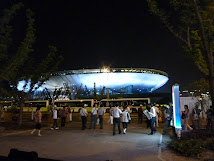
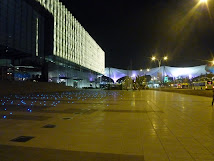
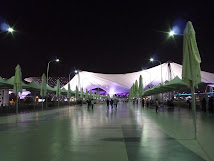
UBPA in the evening
 

Bremen Town Musicians Night Show at the UBPA


Sunday, August 8, 2010

Recommended Expo Entrance Route - Less Walking and Less Exposure to Sunlight

Map showing the way to Expo Gate 9
Today, August 8, 2010, marks the 100th day of the World Exposition 2010 since its opening in Shanghai. As to date, the total accumulated numbers of visitors have exceeded 37 millions. With a huge amount of visitor flow each day, many people are keen to identify the easiest route for Expo entries. Which is the easiest access entrance gate? Which gate is the one with the least numbers of people waiting? Which gate saves visitors' energy in walking? Which gate provides more shades? In addition to the entrance gate information that I have written on June 16, 2010, I am going to provide you with the update condition that I have experienced.  
Expo Entrance Gate 9
On the first day of our arrival at Shanghai in the July visit, we planned to go to the Expo in the evening on the same day. We traveled to the Madang Road MTR station via Metro Line 9. To get change to the Metro Line 13 which only serves for the Expo site, we had to go through Expo Entrance Gate 9 on the ground level. Please refer to the map from the attached photo that I had taken from the signboard at the Madang Road Metro Station. After we had got out of the underground, we walked along a street without any shades for about 15 minutes to reach Expo Gate 9. The sunlight was still strong even though it had already been 5 o'clock in the late afternoon. Fortunately, there were only a few visitors waiting for the security check at Gate 9. The waiting area was empty, and there were cooling mists released from the top of the shelters to lower the temperature of the environment. Please refer to the video below. After we had passed Gate 9, we went straight to the underground (Line 13). Getting off the train at the Shibo Avenue Station, we reached Zone C of Expo Pudong section. Due to the distance walk for the link of Metro Line 9 and 13, I personally won't put this route as a first priority for recommendations. However, if people would like to go to the southeast of Zone C or west of Zone B, this route facilitates their traveling. 
The area in front of Entrance Gate 8
As mentioned in my previous blog dated June 16, 2010, the Expo Entrance Gate 8, Houtan Road, receives the greatest number of visitors each day. The distance between the Houtan Metro Station and Expo Entrance Gate 8 is around 20 minutes walk, and there are not any shades. Due to the availability of the free shuttle bus for the connection of the Metro station with the Expo gate, visitors can save their energy for the walk. However, if you go there during peak hours, you may need to spend tremendous time in queuing for the shuttle bus. We didn't meet crowds of people as we reached there at 11:00am. In the waiting area of the gate, there are more shades, and there are more pipes delivering cooling mists. After passing through the gate, visitors need to take a 15-minute walk across a large square to reach the nearest pavilion or shuttle bus stop. There are not any shades in the square.This route may have more chance to expose to sunlight. However, if people will target to go to Zone C for the European National Pavilions, this is the fastest route.
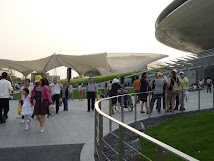
Pedestrian walkway Entrance Gate 2
We have tried various admission routes. Among all, I prefer going via Expo Entrance Gate 2 because it is just located by the side of the South Xizang Road Metro Station. This saves visitors' energy for the walk from the metro station to the Expo entrance. Visitor flow is comparatively small at this entrance as this is the Puxi section of less interest to visitors. When we reached this gate at 09:00am, the peak hour, there were not many people waiting for the security check. Therefore, we quickly passed the gate. After getting into the Expo site, we walked for less than 15 minutes under the shades on the elevated pedestrian walkway to reach the shuttle bus stop. One of the bus routes goes within the area of Puxi. Another bus route goes to Pudong via the cross-river tunnel. We got onto the cross-river bus, and it took 6 minutes to reach the first stop at Pudong. This stop is sited in the area behind the Japan Pavilion. Out of our expectation, this bus route is quick and convenient. If we took the ferry, we would at least wait for half an hour. The bus continues going along the Shibo Avenue in where many popular pavilions can be accessed. I find this route with the least walking distance to reach our targeted pavilions. This route is the one with least exposure to sunlight. Therefore, Expo Entrance Gate 2 is my recommendation.

Expo Entrance Gate 9, Madang Road, with release of cooling mists to lower the temperature of the environment