Showing posts with label UBPA. Show all posts

Thursday, September 30, 2010

A Green Idea at Alsace Case Pavilion of France in Expo 2010 Shanghai

Alsace Case Pavilion
City Pavilions display best urban practices at World Expo 2010 in Shanghai. Many of them have adopted an idea to promote low-carbon lifestyle. The Alsace Case Pavilion is one of the three French regions participating independently in Expo 2010 (The other two regions are Paris and Rhone-Alpes). Located at the Urban Best Practices Area (UBPA) in the Expo Puxi section, the Alsace Case Pavilion demonstrates a construction model in energy saving and environmental protection. The model applies a unique way using solar and water power to generate domestic electricity for cooling and heating systems in summer and winter respectively. The power is generated using the capsule-type solar water curtain wall technology. On the frontal part of the pavilion building, there is a water-skin solar powered wall. Next to the water-skin wall, there is an amazing green wall filled with living plants.

The water-skin wall consists of two layers of glass panels. Trapped air in the wall layers is pumped up to the roof of the building and circulated back by the solar power which is channeled through photovoltaic panels. The external window-type glass panes automatically open and close in the adjustment to the sunlight intensity and outdoor temperature. Such adjustment helps saving energy by providing sunshades and allowing air circulation into the wall layers. During the summer time, the outer glass panes open and water keeps pouring down on the inner glass panes to cool down the indoor temperature.

This interesting system is just like our skin that can breathe to maintain body temperature at a stable level.


The green building Alsace Case Pavilion

Tuesday, August 31, 2010

Cases Joint Pavilion in UBPA Expo 2010 Shanghai

Cases Joint Pavilion 2
Global countries are key participants of world expositions. Worldwide cities start playing an important role in the exhibitions this year. To demonstrate the best practice examples in urban constructions and development, more than 50 represented cities are staging at the Urban Best Practices Area (UBPA) in Expo 2010 Shanghai. City cases come from Europe, America, Asia, and Africa. In the exhibitions, some cities own individual pavilion buildings while some shares under the same roof in a Cases Joint Pavilion. There are in total 4 Cases Joint Pavilions.
Cases of Montreal, Bremen, Freiburg, Guangzhou, Ahmedabad, and Italian Ministry for Environment, Sea and Land are exhibited in the Cases Joint Pavilion 2 at Central UBPA, Zone E.  The Montreal Case Pavilion of Canada has been reported in my previous blog dated August 29, 2010. The Bremen Case of Germany presents energy efficiency and sustainable transport. The focus of the Guangzhou Case of China is "Green Land Action" for sustainable urban development and water environment management. The Ahmedabad Case of India showcases  a traditional residential mansion, Haveli, with the design for sunshades and  ventilation to relieve heat. The Italian Ministry exhibits sustainable cities. Please see attached videos.


Inside Cases Joint Pavilion 2


Inside the "Italy sustainable cities"

Sunday, August 29, 2010

Wisdom of the Montreal Best Practices Case

Montreal Case Pavilion
In writing this blog I would like to express my feelings of thankfulness to the sincere pavilion guides of the Montreal Case Pavilion which is located at the Urban Best Practices Area (UBPA) in Expo 2010 Shanghai. Montreal, a big city in Canada, hosted the world exposition in 1967. This year it participates in Expo 2010 by demonstrating its outstanding project in sustainable urban development. The project, namely Saint-Michel environmental complex, is Montreal's brilliant achievement in solving environmental problem for a site spoiled by industrial exploitation and later served as garbage landfills in a total years more than a century. In a rehabilitation plan in 1995, the Montreal's municipal government turned this limestone-quarry and landfill site into a large public park. The site's contaminated soil and residual materials were safely managed. The successful rehabilitation of the land has contributed to environmental improvement that brings better quality of city life to the citizens.
Exhibition hall
The story of the Saint-Michel environmental complex is presented with a multimedia projection on a screen which is composed of numerous movable blocks. The screen is set at a 45 degree angle to enhance a special visual effect. During the movie presentation, facets of blocks from the screen gently move up and down to give out a dynamic view. The movie takes visitors onto a vivid journey witnessing the marvelous transformation of a scrappy land into a spectacular complex. The multimedia hall at the Montreal Case Pavilion is not large, but the presentation is unique and outstanding. The design of the projection screen is creative and wonderful. It is impressive to see a screen in motion. How clever the Montrealers are.

David, a pavilion guide
David, who was one of the pavilion guides, gave us some useful and interesting information regarding the Saint-Michel environmental complex when we were waiting at the entrance of the multimedia hall. We were grateful to his kindness. The written explanation was indeed posted on the wall of the pavilion, but we had missed them. David told us that explanation would be given inside the hall from following weeks onwards. Upon our arrival at the Montreal Case Pavilion, there were only a few visitors. We waited for about 10 minutes to attend the movie presentation. The information given by David contributed to our enjoyment and profound understanding of the Saint-Michel story. Out of the multimedia hall after watching the show, we peeped through the tiny windows to find out the secrets behind the screen. There were a great number of metal rods moving up and down to support the movement of the screen blocks. Please refer to the video below. It was great that the organizer of the pavilion let us watch the back of the screen. Such arrangement stimulated our creative thinking.

Pavilion guides - Marie-Pierre (L), Claire (R)
In the final part of our touring at the Montreal Case Pavilion, we enjoyed chatting with two sweet girls who were also pavilion guides. In a friendly atmosphere, we learned more about Montreal. It was fantastic. By then, I felt that world expositions are international meeting points for global knowledge exchange. I noticed that there was another male pavilion guide giving information to the visitors in Mandarin. I was amazed to see a young Canadian speaking beautiful Mandarin. All of these pavilion guides make the exhibition become interactive and communicative. They have contributed to the promotion in building a good national image for their country. After I had got back to Hong Kong, I searched relevant information regarding the Montreal Case. The pavilion guides whom I met are among the 8 volunteers/ interns selected from 150 applicants to work for the Montreal Case Pavilion, and they are going back to Montreal on August 31, 2010 to continue their student life. There are more information about them from the website of Conseil jeunesse de Montreal (CJM Montreal Council). I saw their pictures and videos. However, I couldn't understand the content because the website is written in French.

With the kind permissions from the young pavilion guides of the Montreal Case Pavilion, I posted their photographs on my blog so as to keep this meaningful memory (See attached images). May I take this opportunity to say "Thank you" to all of them and wish them all the best in future.

Multimedia screen composing of numerous movable blocks


The secret behind the movable screen which is composed of numerous blocks.

Thursday, August 19, 2010

Enjoying the Leisure of Shanghai Expo 2010 without Any Crowds

A garden in UBPA
While hundreds of thousands of people were flooding into the Pudong region where national pavilions of Asia, Middle East, and Europe are located, we explored the peaceful side of the Shanghai World Exposition across the Huangpu River in the Puxi area. And we had achieved enjoying the leisure of the Expo 2010 without any crowds in the Urban Best Practices Area (UBPA). The UBPA is an exhibition district for representative cities around the world to showcase their innovative practices in urbanization. The UBPA also acts as a platform to connect cities in sharing their experiences in urban construction and development. Various representative cases are shown via exhibitions, presentations, seminars, workshops, networks, display boards, events, and performances. Showcase portfolios demonstrate a remarkable range of implementations and solutions to improve the quality of city life. Sample displays include low-carbon city, eco-housing, eco-art, sustainable urbanization, utilization of culture heritage, and technological innovations in built environment, etc. Apparently, UBPA is a good place for learning rather than entertainment.
Eco Housing
The UBPA includes a number of case pavilions and four Cases Joint Pavilions. Please refer to the page end of the Site Maps and Pavilions to view a full list of the presenting city cases from various geographical regions. In the northern part of the UBPA, built cases are demonstrated in simulated urban blocks. There are Case Pavilions of Alsace, Chengdu, Hamburg, London, Macau, Madrid, Makkah, Ningbo, Odense, Rhone-Alpes, Shanghai, Vancouver, and Xian. All of these case pavilions are close to each other. Therefore, there is no need for visitors to walk a long distance under the strong sunshine from one pavilion to another. In the central and southern part of the UBPA, several presenting cases are sharing under a large Cases Joint Pavilion. The temperature of Shanghai was as high as 35 degree Celsius at the time of our visit. Fortunately, we escaped from the hot weather by staying indoors to see a great variety of exhibitions in the UBPA.
London low-carbon case pavilion
We enjoyed very much our touring in the UBPA. There were no crowds, and the environment was naturally refreshing. We went straight into almost every pavilion without lining up for admission. When we were seeing a queue of more than 15 people, we returned later to achieve a non-waiting admission. Comparing with our first visit experience to the UBPA in May, there were comparatively more people now in July. It is perhaps due to the fact that more people learn about the fast track system requirement in the visits of the UBPA.

We spent a whole day in the UBPA but still had not yet finished seeing the exhibitions in details. There were lots of information to feed our curious mind. Anyway, I had taken photographs on the display board information and would like to learn about them in the later days. Apart from the knowledge acquisition, we also enjoyed the delicious food in the UBPA. There are many restaurants serving gourmet food from various countries. The restaurants were not crowded at all. We took a Spanish dinner at the Madrid Case Pavilion. The food was absolutely gorgeous. After the dinner, we watched the spectacular lighting show which was run by the Rhone-Alpes Lighting Pavilion. And we watched the entertainment show run by the Bremen Town Musicians. What a wonderful relaxing time we had! If possible, we would like to visit the UBPA again. The UBPA is worth visiting. 
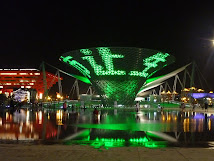
UBPA in the evening
 

Bremen Town Musicians Night Show at the UBPA


Thursday, July 8, 2010

100,000 Visitors Had Benefited from the Fast Track System

Signboard explaining the fast track system
The Shanghai Expo authority yesterday announced that more than 100,000 visitors had benefited from the fast track system to obtain reservation tickets for the designed popular pavilions. During the process, visitors should firstly obtain a copy of the City Name Card. After the card has been stamped with 16 chops from the Urban Best Practices Area (UBPA) Cases (please refer to my blog dated June 12, 2010 for details), the visitor can exchange the card for a reservation ticket to one of the three popular pavilions - the China, Saudi Arabia, or Italy Pavilion. The Italy Pavilion started joining the system this month. In order to be able to get accessed to the Italy National Pavilion, one should go to the Cases of Venice, Bologna and the country's environment protection department to collect 6 UBPA stamps. There are limited editions of the cards. Every day the system offers 500 chances to the admission to the Italy Pavilion, 180 to the Saudi Arabia Pavilion, and 2,000 to the China Pavilion. Visitors who are interested in the Germany, Spain, and Czech Republic Pavilions, may go to the three countries' cases to collect a certain number of stamps. A notice is posted at the Information Counter for the explanation of the procedures (See attached photo). Once you have got the reservation ticket for the China Pavilion, you don't need to follow the time slot. It is quite free. The staff will only check the date. He/ she will let you go in even though the booking time has passed.
UBPA at Puxi section of Expo 2010
The fast track system has made the UBPA become popular. The number of attendances to the UBPA increases to almost 10 folds than that before the initiation of the system. The system has also generated more visitors to Puxi. A university teacher was very lucky to be the 100,000th visitor receiving the City Name Card. The luck had brought him a gift package including reservation tickets to the China, Saudi Arabia, Italy, Germany, and Czech Republic Pavilions.
Besides the offers from the fast track system, one can get accessed to the designated pavilions if he or she holds a valid VIP card. Some foreigners said that they could skip the queue to enter their country's pavilions by showing their legal passports. For example, a visitor who is holding a valid French passport is allowed to get into the France Pavilion straight away. I, however, have no way to validate this information.

Saturday, June 12, 2010

Fast Track to the China Pavilion in Expo 2010

Signboard showing the way
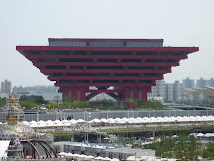
Among the many exhibitions in Expo 2010, the China National Pavilion has been many visitors' top interest. To get access to the China Pavilion, one should firstly get a reservation ticket ready at hand. However, the demand for tickets is far greater than the supply. Therefore, many people feel disappointed in the failure getting a ticket from the reservation spot. There were some discussion messages left on the community networks saying that it was hard to get a reservation ticket. In the following paragraph, I am going to show you an optional route to achieve an access to the China Pavilion. 
Starting from May 19, 2010, there is a fast track option to obtain reserved tickets. After visitors have finished collecting 16 stamps from a visit to the Urban Best Practices Area (UBPA) in the Expo's Puxi Section, they can trade it for a reserved ticket for either China Pavilion or Saudi Arabia Pavilion. The stamps should include 15 UBPA cases (7 Asian, 7 European, and one American/ African cases) and one from the entry point to the site. Stamps should be issued in a booklet entitled "City Name Card" which can be obtained in Zone E, Puxi. There are signs leading you to the site once you are in the area. And there are volunteers helping you for the direction. Please be aware that such fast track is for individual visitors only. Group visitors are not entitled for the fast track offer.
City Name Card for China Pavilion
When we reached the distribution point for the "City Name Card" booklets at around 09:30am, the booklets for the China Pavilion are still available. However, the booklets for the Saudi Arabia Pavilion had all gone. As we are aware, 900 to 1,000 booklets for the China Pavilion will be distributed every day, but only 500 per week to the Saudi Arabia Pavilion. If people can't finish collecting the stamps within the same day, they can continue the collection when coming to the site again. In the reality, people can finish visiting the 15 UBPA cases quickly because there are not much to see and visitors don't need to wait for a moment. Some city cases have only a counter in the UBPA pavilion. After the completion of the 16 stamps, visitors can go to the Puxi Information Center in Zone E for the trading. For updates, please check the official Expo website http://www.expo2010.cn/ in case of any policy changes.
City Name Card for Saudi Arabia Pavilion