Showing posts with label 2010 shanghai expo. Show all posts

Friday, July 9, 2010

Expo Passport - The Best Selling Souvenir at Expo 2010

Stamping Expo passports at France Pavilion
The issue of Expo passports was originated in 1976 Montreal Expo of Canada. Expo passports were served as exposition admission tickets at that time and turned into popular souvenirs in later expositions. Since the opening of the 2010 Shanghai Expo, Expo passports have become the best selling souvenir and are always sold out quickly at the licensed stores inside the Expo park. Souvenir passports which carry the watermarks of different national pavilions on different pages are offered in four colors. Collecting stamps for the passport from visiting pavilions has added a bit of fun to the visits. Enthusiasm for the collection of pavilion stamps persists among visitors. The stamp serves as a proof of the pavilion visit. Most of the stamps are in unique beautiful design. To some visitors, the Expo passport serves as a gift to friends.

Souvenir Expo passport
The majority pavilions provide visitors with the stamping services on the pathway towards the exit. A few pavilions offer the services at the entrance hall. The France Pavilion, perhaps, is the only one giving out stamping services to the visitors in the last few minutes of their queue-up time for admissions (see attached photo 1). I quite like the idea. This makes use of our boring queue-up time. Some pavilions request the stamps to be affixed on the designated pages. For example, the stamp for the France Pavilion has to be put on page 14 which posses a watermark of the image of its pavilion (see attached 2). For long time, we were not aware of the watermarks printed on the passport pages. Until one day, my eyes were caught by the watermark of the "Saudi Arabia Moon Boat" on page 35. It was good that the staff of the Saudi Arabia Pavilion had avoided putting the stamp on its watermark (see attached photo 3).
On our first day of the Shanghai Expo tour in May 2010, we entered the site at Puxi. As there were fewer souvenir shops in Puxi than Pudong and our first priority was going to get the City Name Card, we failed to purchase the passport. On the second day, we got it right after our admission to Pudong. We purchased one for each of us. My husband had his passport stamped while I kept my passport blank. Although we understood that a passport with a full collection of stamps could be bid for a few hundred to a few thousand RMB dollars, we were not too fancy about the stamp collection. I wonder who will be so silly to spend a few thousand RMB dollars to purchase a stamped passport souvenir.
Watermarks of different national pavilions
Regarding the stamp collection, I read some negative reports on the internet. An article mentioned that some visitors were holding a few hundred passports for stamping, and some left the pavilions without any touring right after they had obtained the stamps. In our experiences, we did not see these pictures. Such rumors are questionable. In the reality, all visitors have to do their stamping quickly because there is always a long queue moving behind you.  It is not feasible for a person to take up some time to stamp a few dozens passports. The long queue will certainly push him/ her go. For the popular pavilions, people need to line up for hours to reach the stamping counter. Will they solely come for the stamps but not the touring after queuing for a few hours? For the pavilions which are lack of attractions, it is reasonable that people take a quick glance and turn to other pavilions. If people are fancy in the collection of stamps, they can get many stamps from the Africa Pavilion. There are 42 countries and one organization in the Africa Pavilion. Similarly, visitors can obtain a number of stamps from the Urban Best Practices Area in Puxi. I saw some people ask to have the stamps chopped on their Expo maps because they didn't have any passports. This worked.
A new version of Expo passports was released on June 22, 2010. Anti-counterfeiting technologies have been added to the passports. There are not any more pavilion background patterns on the pages or the page number footnote. The supply of the Expo passport is now sufficient. If visitors still can't get a passport, they may try the souvenir shops with a low traffic volume. There is one at the basement level of the Expo Axis providing rich stock of souvenir passports. 

Thursday, July 8, 2010

100,000 Visitors Had Benefited from the Fast Track System

Signboard explaining the fast track system
The Shanghai Expo authority yesterday announced that more than 100,000 visitors had benefited from the fast track system to obtain reservation tickets for the designed popular pavilions. During the process, visitors should firstly obtain a copy of the City Name Card. After the card has been stamped with 16 chops from the Urban Best Practices Area (UBPA) Cases (please refer to my blog dated June 12, 2010 for details), the visitor can exchange the card for a reservation ticket to one of the three popular pavilions - the China, Saudi Arabia, or Italy Pavilion. The Italy Pavilion started joining the system this month. In order to be able to get accessed to the Italy National Pavilion, one should go to the Cases of Venice, Bologna and the country's environment protection department to collect 6 UBPA stamps. There are limited editions of the cards. Every day the system offers 500 chances to the admission to the Italy Pavilion, 180 to the Saudi Arabia Pavilion, and 2,000 to the China Pavilion. Visitors who are interested in the Germany, Spain, and Czech Republic Pavilions, may go to the three countries' cases to collect a certain number of stamps. A notice is posted at the Information Counter for the explanation of the procedures (See attached photo). Once you have got the reservation ticket for the China Pavilion, you don't need to follow the time slot. It is quite free. The staff will only check the date. He/ she will let you go in even though the booking time has passed.
UBPA at Puxi section of Expo 2010
The fast track system has made the UBPA become popular. The number of attendances to the UBPA increases to almost 10 folds than that before the initiation of the system. The system has also generated more visitors to Puxi. A university teacher was very lucky to be the 100,000th visitor receiving the City Name Card. The luck had brought him a gift package including reservation tickets to the China, Saudi Arabia, Italy, Germany, and Czech Republic Pavilions.
Besides the offers from the fast track system, one can get accessed to the designated pavilions if he or she holds a valid VIP card. Some foreigners said that they could skip the queue to enter their country's pavilions by showing their legal passports. For example, a visitor who is holding a valid French passport is allowed to get into the France Pavilion straight away. I, however, have no way to validate this information.

Wednesday, June 30, 2010

The Charm of the Saudi Arabia Pavilion - Expo 2010

Saudi Arabia Pavilion
Why are there always extremely long queues snaked around the Saudi Arabia Pavilion in Shanghai Expo 2010? The longest queue-up time was once estimated to be 9 hours. It's crazy. What is in the pavilion? Many people raise a great curiosity about the attractions of the Saudi Arabia Pavilion. Is it worth spending tremendous time on the queues? Only after I have visited the Saudi Arabia Pavilion, I start understanding why a great number of visitors are willing to sacrifice their time for the admissions. My friends who have visited Saudi Arabia Pavilion agree with me that the pavilion has given us a beautiful memory.
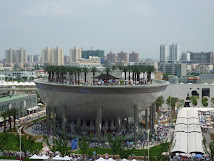
The outlook of Saudi Arabia Pavilion is super charming. It features a giant hanging boat shaped like a half moon resting with a dozen of steel poles on the elevated ground. Underneath are pools, fountains, and gardens. When entering the garden, visitors will see a barrier in the style of a mini Chinese Great Wall. When leaving the garden, people will see date palm trees stand along both sides of the exit. Along the edge of the moon boat that is high up in the sky, a large belt-shaped TV revolving screen presents various artistic patterns in turns with welcome notices in different languages. Date palms are also planted on the top deck of the boat to form part of the rooftop garden. The boat appears to be full of dreams and imaginations.
The spiral walkway
After we had entered the pavilion, we walked up along a ramp. Both the entrance and exit pathways form part of the atrium hall. The entrance in the form of a continuous upward spiral ramp was on the outer circle of the atrium, while the exit pathway was located at the inner circle in spiral downward direction. There was a transparent barrier separated the entrance and exit pathways. A fountain was sited at the ground level in the hollow center of the atrium hall. After walking up for about three circles' turns, we reached the top level of the boat. We saw a warning notice before getting into the main pavilion. The notice wrote, "The film may cause dizziness. For those who suffer from heart disease or hypertension, please consider carefully". Passing through the door, we stepped onto a conveyor belt. The conveyor made us move slowly along the body of a round-shape giant theater. Initially, we were in the darkness. But then, we found ourselves embraced by a huge inverted movie screen. The huge concave screen was far under our feet and extended to our sides. This is the largest cinema in the world, I believe. The movie introduced the distinct features of Saudi Arabia including their people, natural environment, cities, culture, lifestyles, and arts. I loved the background music which seemed to be in Arabic style. It gave us a sense of comfort, like flying over wild fields. Following the movie' pathways to various areas in Saudi Arabia, we felt that we had experienced a journey of thousand miles. As we were standing on the moving conveyor and the desserts and oases moved from far to close projections below us, we had a feeling like staying on a flying saucer. It was grand and amazing. The journey was wonderful and fantastic.
Exit of the Saudi Arabia Pavilion


A wonderful journey in the Saudi Arabia Pavilion


On the top of the Moon Boat

Monday, June 28, 2010

"Super Rice" Growth at Expo 2010 shanghai

Super rice planting
World expositions are optimal places for acquiring knowledge. Before visiting Shanghai Expo 2010, I have never thought of learning something about rice. I know little about agricultural planting. After I have been to the "super rice" exhibition at China Pavilion in Expo 2010, I start realizing that the Chinese government has been putting very much effort on the research of hybrid rice engineering technology. Super rice is China's key agricultural development with phase accomplishment in rice increase production. What is super rice? It is interesting to learn about it.
What is super rice?
Hybrid rice is produced by crossbreeding of different types of rice. Super rice refers to the rice variety that has a significant increase output. In the section "Land of Hope" at China pavilion, live super rice plants were displayed. They appeared to be healthily tall and strong. Grains were in golden color. The staff of the pavilion introduced the super rice to us. It is the latest specie of high-yield hybrid rice developed by the "Father of Hybrid Rice" Yuan Longping and co-researchers. The study of super rice is an on-going project since the birth of the first generation of hybrid rice in 1970's. The current variety of super rice has more than  30% output than the ordinary rice. In order to display the flowering plants, 16 batches of super rice had been planted with different seedling time. Each batch of super rice would be transferred to the display  area and stayed there for 7 to 10 days. The first batch of flowering super rice had been transported to China Pavilion, and the rice seeded in May would be matured in September.


The Land of Hope at China Pavilion in where the super rice is shown

Monday, June 21, 2010

China Pavilion at Expo 2010

China Pavilion
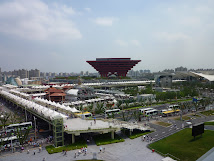
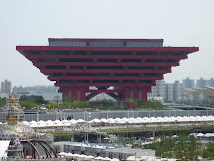
The China Pavilion is the top  attraction in 2010 Shanghai Expo. Its building is grand and magnificent, blending the modern architecture with a taste of the ancient Chinese culture. The theme of the China Pavilion features the Chinese wisdom in urban development. In the first section of the exhibition, we watched a short movie which showed cases of Chinese's experiences in urbanization over the past 30 years. We then moved to the main gallery in where we were fascinated to see a giant animated rendition lively presenting a scene of Chinese people' activities during a festival back to the days 900 years ago. The scene is an imitation of the famous ancient Chinese painting scroll "Riverside Scene at Qingming Festival". In the picture, animated characters were shouldering commodities, selling groceries, riding donkeys, enjoying dinners, rowing boats, etc. We strolled along the "bank" of the animated "river" which stayed right below the 128 meter-long animated rendition. Referring as one of the China's national treasures, the real painting of the "Riverside Scene at Qingming Festival" was also displayed in the pavilion. Other displays were valuable antiques in the hall "Crystals of civilization".
Architecture China Pavilion
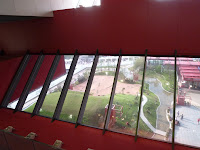
In the second section, we came to the "Land of Hope". There were projections of future apartments showing how people would improve their quality of life in cities. In the agricultural area, there were displays of super rice which were tall and strong. One of the signboard's indications was the emphasis of rural-urban harmony. In further explorations, we entered the hallway in where children paintings were displayed. Peeping through the glass wall of the hallway, we could view distant scenery of the Expo site and people lining up in front of the China Pavilion. We were, in fact, staying as high as in a modern high-rise building. Getting into another exhibition hall, we found a chance to rest our tired legs by riding an excursion train. The train tour offered us a dynamic and exciting journey of discovery and enabled us to learn about Chinese wisdom in city planning. 
Looking down from the China Pavilion

The final section of the exhibition expressed the  effort of the Chinese government in the advocacy of low-carbon lifestyle to its citizens. Energy saving facilities such as wind power generators and LED bulbs were displayed. Reaching the end of the exhibition hall, we came to a large ring-shape lotus pond surrounded by sliding rains. We got into the center part of the lotus pond and stepped onto the extraordinarily long escalator which sent us down to the open-area podium. Passing the Chinese garden, we got our way to the exit. 


Watching the animated painting scroll


Part of the animated version of the ancient Chinese Painting scroll "Riverside Scene at Qingming Festival" 


The greatest attraction in the China Pavilion