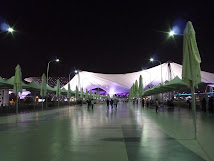
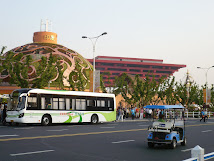
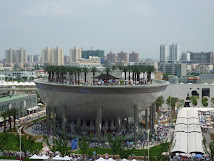
ZED stands for Zero Energy Development. A ZED is a building that generates sufficient renewable energy for its site's use. The ZED Pavilion, situated at the Urban Best Practices Area in Shanghai Expo 2010, is the first zero carbon building model exhibited in world expositions. The ZED Pavilion demonstrates the design of zero energy. The pavilion building simulates a large-scale zero carbon development in the United Kingdom. In the project, natural energy such as solar power, wind and water power are used. The pavilion building applies low carbon concrete structure, solar sading, Nano coating of exterior wall, super insulated wall, thermal mass, low-e glass, sun spaces, thin film-PV, FSC timber, solar power dehumidification, rainwater recycle, specific water supply system, LED lighting, and green roof.
In the displays, we learn about biofuels, hydrogen power, and how waste water streams can be turned into power. There is a research collaboration between the universities in the UK and China. Research achievement includes the development of a unique-type of temperature reactive window coating that reduces the need for air-conditioning. Using cutting-edge nanotechnology, scientists in Nottingham and China are developing a new generation of high-performance low-cost solar cells.
City Pavilions display best urban practices at World Expo 2010 in Shanghai. Many of them have adopted an idea to promote low-carbon lifestyle. The Alsace Case Pavilion is one of the three French regions participating independently in Expo 2010 (The other two regions are Paris and Rhone-Alpes). Located at the Urban Best Practices Area (UBPA) in the Expo Puxi section, the Alsace Case Pavilion demonstrates a construction model in energy saving and environmental protection. The model applies a unique way using solar and water power to generate domestic electricity for cooling and heating systems in summer and winter respectively. The power is generated using the capsule-type solar water curtain wall technology. On the frontal part of the pavilion building, there is a water-skin solar powered wall. Next to the water-skin wall, there is an amazing green wall filled with living plants.
The water-skin wall consists of two layers of glass panels. Trapped air in the wall layers is pumped up to the roof of the building and circulated back by the solar power which is channeled through photovoltaic panels. The external window-type glass panes automatically open and close in the adjustment to the sunlight intensity and outdoor temperature. Such adjustment helps saving energy by providing sunshades and allowing air circulation into the wall layers. During the summer time, the outer glass panes open and water keeps pouring down on the inner glass panes to cool down the indoor temperature.
This interesting system is just like our skin that can breathe to maintain body temperature at a stable level.
Madrid, the capital of Spain, is one of the greenish cities in the world. Owning a case pavilion at the Urban Best Practices Area (UBPA) in Expo 2010 Shanghai, Madrid demonstrates an environmental friendly social housing project as developed by its municipal government for the low-income citizens. There are two parts in the exhibitions, namely the Bamboo House and Air Tree. The Bamboo House mainly serves for displays and exhibitions. The Air Tree provides visitors with a comfortable open area for a rest. The exhibition pathway begins at the top floor of the Bamboo House, and it is connected with an escalator from the ground level where visitors are waiting for admissions. There are separated entrances leading to the Spanish restaurant and souvenir shop. The entire building duplicates the design of the Madrid public housing with the application of ecological materials and installation of renewable energy resources. The outer layer of the House is encrusted with bamboo bark for the purpose of temperature control as well as noise insulation.
Bamboo House (L), Air Tree (R)
The Air Tree, which is adjacent to the Bamboo House, is a cylindrical structure covered all around with large movable window shades. During the day, shades are open to facilitate natural ventilation in the Air Tree. When shades are closed, they become the double-side projection screens for movies and light show performances in the evening. Wind wheels are equipped on the top of the structure, and there is a giant fan turning to ventilate the area under the Tree. Visitors enjoy listening to the lovely music while resting in a refreshing area. The Air Tree can also be served as a platform for a mini concert.
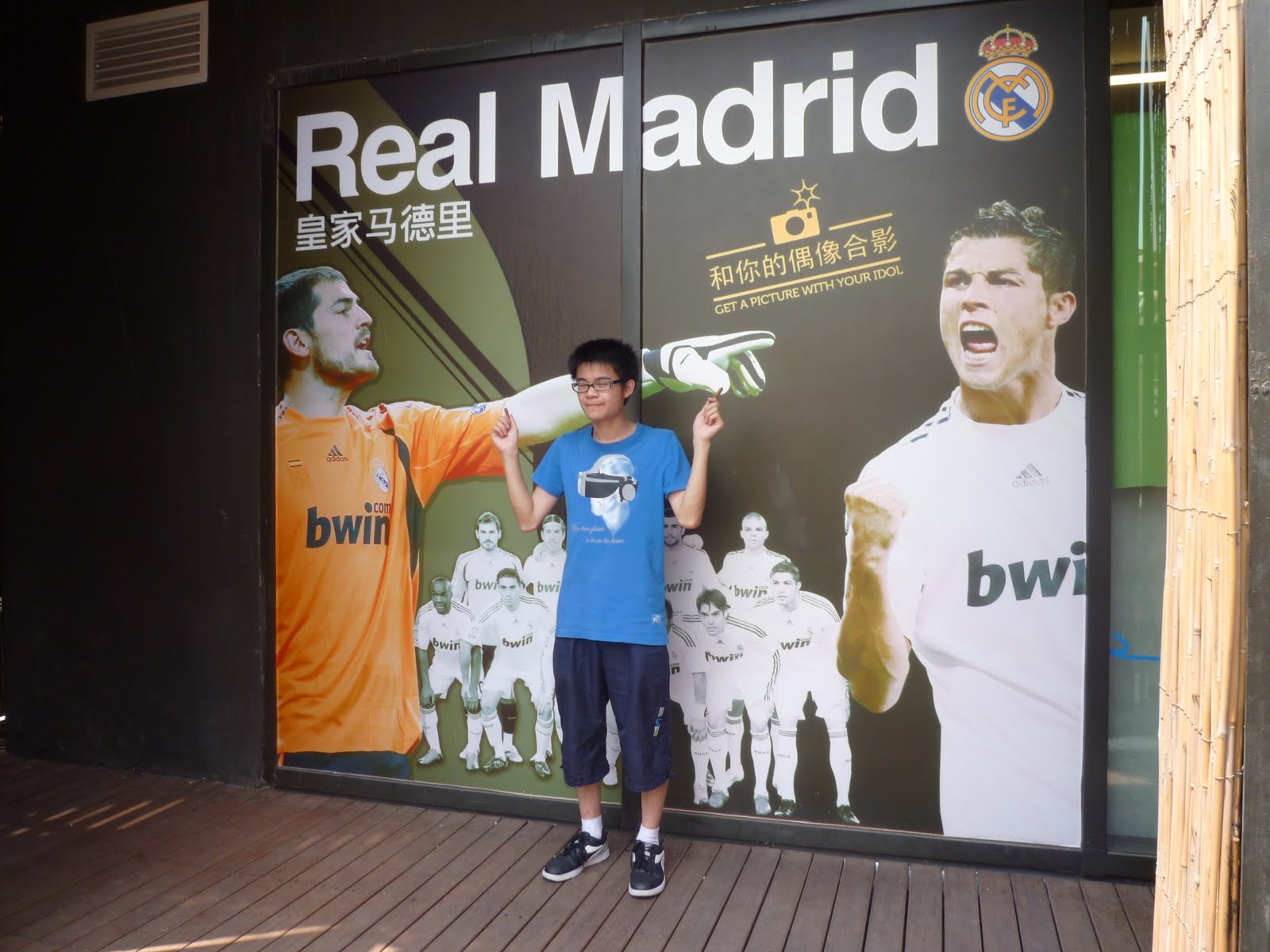
If you visit the Madrid Case Pavilion for the purpose of collecting a stamp, the Pavilion will not make you feel disappointed. A full collection of the stamps from the Madrid, Bilbao, and Barcelona Case Pavilions for your Expo passport will give you the priority to enter the Spain Pavilion through the fast access channel. If you are a fans of the Real Madrid Football Club, you will certainly get something that makes you feel excited.
A mini concert under the Air Tree at the Madrid Case Pavilion UBPA
While hundreds of thousands of people were flooding into the Pudong region where national pavilions of Asia, Middle East, and Europe are located, we explored the peaceful side of the Shanghai World Exposition across the Huangpu River in the Puxi area. And we had achieved enjoying the leisure of the Expo 2010 without any crowds in the Urban Best Practices Area (UBPA). The UBPA is an exhibition district for representative cities around the world to showcase their innovative practices in urbanization. The UBPA also acts as a platform to connect cities in sharing their experiences in urban construction and development. Various representative cases are shown via exhibitions, presentations, seminars, workshops, networks, display boards, events, and performances. Showcase portfolios demonstrate a remarkable range of implementations and solutions to improve the quality of city life. Sample displays include low-carbon city, eco-housing, eco-art, sustainable urbanization, utilization of culture heritage, and technological innovations in built environment, etc. Apparently, UBPA is a good place for learning rather than entertainment.
Eco Housing
The UBPA includes a number of case pavilions and four Cases Joint Pavilions. Please refer to the page end of the Site Maps and Pavilions to view a full list of the presenting city cases from various geographical regions. In the northern part of the UBPA, built cases are demonstrated in simulated urban blocks. There are Case Pavilions of Alsace, Chengdu, Hamburg, London, Macau, Madrid, Makkah, Ningbo, Odense, Rhone-Alpes, Shanghai, Vancouver, and Xian. All of these case pavilions are close to each other. Therefore, there is no need for visitors to walk a long distance under the strong sunshine from one pavilion to another. In the central and southern part of the UBPA, several presenting cases are sharing under a large Cases Joint Pavilion. The temperature of Shanghai was as high as 35 degree Celsius at the time of our visit. Fortunately, we escaped from the hot weather by staying indoors to see a great variety of exhibitions in the UBPA.
London low-carbon case pavilion
We enjoyed very much our touring in the UBPA. There were no crowds, and the environment was naturally refreshing. We went straight into almost every pavilion without lining up for admission. When we were seeing a queue of more than 15 people, we returned later to achieve a non-waiting admission. Comparing with our first visit experience to the UBPA in May, there were comparatively more people now in July. It is perhaps due to the fact that more people learn about the fast track system requirement in the visits of the UBPA.
We spent a whole day in the UBPA but still had not yet finished seeing the exhibitions in details. There were lots of information to feed our curious mind. Anyway, I had taken photographs on the display board information and would like to learn about them in the later days. Apart from the knowledge acquisition, we also enjoyed the delicious food in the UBPA. There are many restaurants serving gourmet food from various countries. The restaurants were not crowded at all. We took a Spanish dinner at the Madrid Case Pavilion. The food was absolutely gorgeous. After the dinner, we watched the spectacular lighting show which was run by the Rhone-Alpes Lighting Pavilion. And we watched the entertainment show run by the Bremen Town Musicians. What a wonderful relaxing time we had! If possible, we would like to visit the UBPA again. The UBPA is worth visiting.
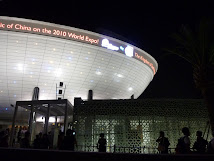
Among the many exhibitions in Expo 2010, the China National Pavilion has been many visitors' top interest. To get access to the China Pavilion, one should firstly get a reservation ticket ready at hand. However, the demand for tickets is far greater than the supply. Therefore, many people feel disappointed in the failure getting a ticket from the reservation spot. There were some discussion messages left on the community networks saying that it was hard to get a reservation ticket. In the following paragraph, I am going to show you an optional route to achieve an access to the China Pavilion.
Starting from May 19, 2010, there is a fast track option to obtain reserved tickets. After visitors have finished collecting 16 stamps from a visit to the Urban Best Practices Area (UBPA) in the Expo's Puxi Section, they can trade it for a reserved ticket for either China Pavilion or Saudi Arabia Pavilion. The stamps should include 15 UBPA cases (7 Asian, 7 European, and one American/ African cases) and one from the entry point to the site. Stamps should be issued in a booklet entitled "City Name Card" which can be obtained in Zone E, Puxi. There are signs leading you to the site once you are in the area. And there are volunteers helping you for the direction. Please be aware that such fast track is for individual visitors only. Group visitors are not entitled for the fast track offer.
City Name Card for China Pavilion
When we reached the distribution point for the "City Name Card" booklets at around 09:30am, the booklets for the China Pavilion are still available. However, the booklets for the Saudi Arabia Pavilion had all gone. As we are aware, 900 to 1,000 booklets for the China Pavilion will be distributed every day, but only 500 per week to the Saudi Arabia Pavilion. If people can't finish collecting the stamps within the same day, they can continue the collection when coming to the site again. In the reality, people can finish visiting the 15 UBPA cases quickly because there are not much to see and visitors don't need to wait for a moment. Some city cases have only a counter in the UBPA pavilion. After the completion of the 16 stamps, visitors can go to the Puxi Information Center in Zone E for the trading. For updates, please check the official Expo website http://www.expo2010.cn/ in case of any policy changes.
I love reading, studying, traveling and sightseeing. I have visited a number of countries over the world. I enjoyed my previous visits in several world expositions. The Shanghai Expo 2010 is on the top of my interest. I, therefore, would like to keep the beautiful memory by writing a blog.